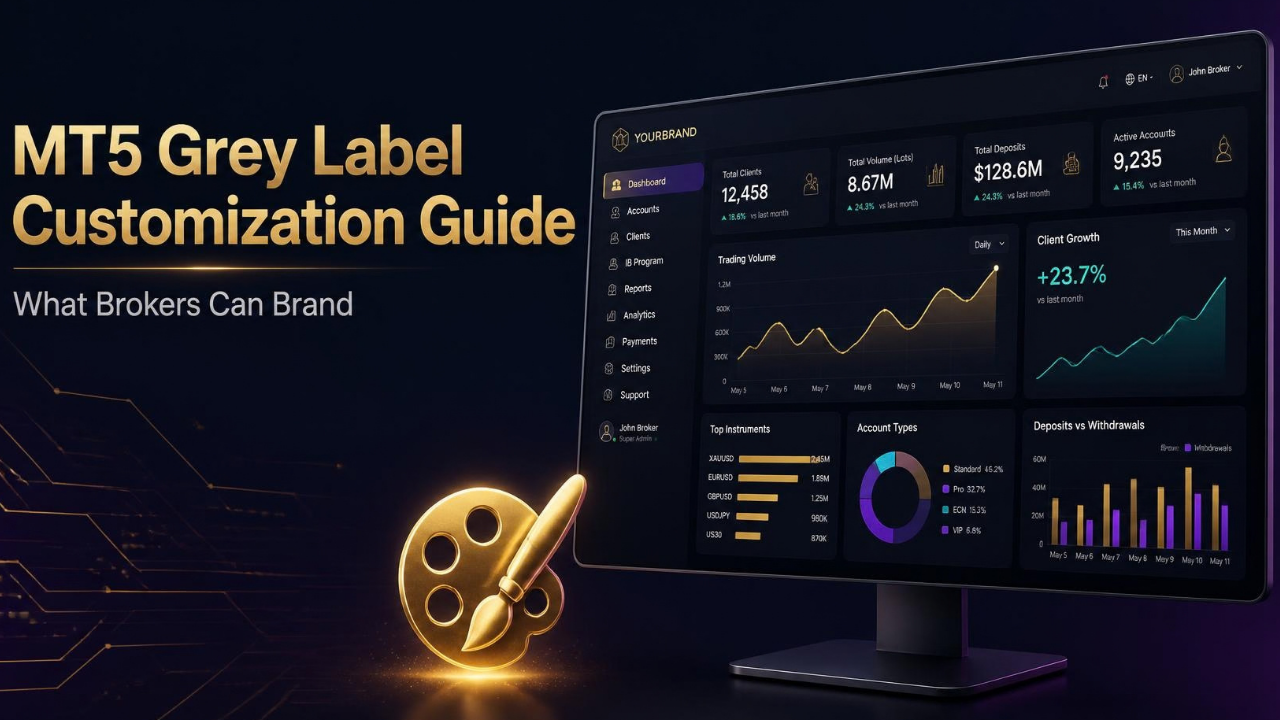
When brokers compare launch models, most of the conversation focuses on cost and speed — and rightly so, since MT5 Grey Label wins on both counts. But a question that comes up almost as often, usually after the pricing conversation is settled, is simpler and harder to answer cleanly: how much of the platform can a broker actually make their own? "Grey" sits deliberately between "white" (fully yours) and an unbranded reseller arrangement, and that middle position is exactly where confusion creeps in. This guide breaks down, section by section, what a broker running on this model can brand and control outright, what stays with the infrastructure provider, and how to plan around those boundaries instead of being surprised by them after signing.
🎨 What "Customization" Actually Means Under MT5 Grey Label
The term grey label describes a shared-infrastructure model: the trading server, core licensing, and much of the backend plumbing remain owned and operated by the provider, while the broker-facing layer — the parts your clients actually see and interact with — is opened up for branding. Understanding that split is the key to understanding everything else in this article. MT5 Grey Label customization is front-end and client-experience customization, not infrastructure ownership. That's a deliberate trade-off, not a limitation to work around: it's precisely what keeps setup timelines short and upfront costs low compared with a full MT5 White Label deployment, where the broker takes on the license, the server relationship, and the operational responsibility that comes with both.
In practice, this means a new broker evaluating Grey Label should walk in with two separate checklists: one for what needs to look and feel like their own brand, and one for what they're comfortable delegating entirely to the provider. Most brokers find that the first list covers everything a client actually notices day to day, while the second list covers things clients never see at all.
🖌️ Branding Elements You Can Fully Control
This is the part of MT5 Grey Label that surprises brokers in a good way — the list of client-facing elements available for full branding is longer than the "grey" name implies. Typically included:
- ✓ Company name, logo, and color scheme across the client portal and trading terminal skin
- ✓ Custom domain and URL for the client area and website
- ✓ Branded email templates for account confirmations, deposit notices, and marketing communications
- ✓ Client-facing documentation, onboarding flow, and support contact details
- ✓ Marketing pages, landing pages, and promotional material tied to your own brand identity
Because these are the elements a trader interacts with from the first click, a well-executed branding pass can make a MT5 Grey Label setup indistinguishable from a full white-label brokerage in the eyes of the end client. The backend arrangement is invisible to them, which is exactly the point.
• • •
⚙️ What Stays With the Provider (and Why That's the Point)
On the other side of the ledger, several components are intentionally kept out of broker hands under Grey Label, because taking them on is what turns a Grey Label deployment into a White Label one. These typically include the trading server license itself, direct relationships with liquidity providers and bridge configuration, core server infrastructure and uptime management, and regulatory or platform-vendor licensing obligations tied to running MT4 or MT5 as the license holder of record. A broker on Grey Label leans on the provider's existing licensing and infrastructure relationships rather than building or holding those relationships independently.
This isn't a workaround or a downgrade — it's the mechanism that makes MT5 Grey Label faster and cheaper to launch than a full build. Every piece of infrastructure a broker doesn't have to negotiate, license, or maintain directly is time and capital that goes toward acquiring clients instead. Brokers who outgrow these limits later have a clear, well-trodden path to a full MT5 Grey Label to White Label migration, but it's worth entering the arrangement understanding exactly where that line sits from day one.
📊 Grey Label vs White Label: Customization Side by Side
Because the two models are so often confused, it helps to see the customization boundaries laid out directly against each other.
| Customization Area | Grey Label | White Label |
|---|---|---|
| Branding, logo, and color scheme | Full control | Full control |
| Custom client area domain | Yes, typically included | Yes |
| Mobile app branding | Limited, provider-dependent | Full control, own app listing |
| Trading server license | Held by provider | Held by broker |
| Liquidity and bridge setup | Managed by provider | Broker-configurable |
| Typical setup timeline | Days to a few weeks | Several weeks to months |
| Upfront cost | Lower | Higher |
Read this table less as "which model is better" and more as "which trade-offs fit my stage." Early-stage brokers usually value the speed and lower cost of Grey Label enough to accept the infrastructure limits, while established brokers with a larger client base often value the deeper control a MT5 White Label setup provides enough to justify the added cost and timeline.
✅ A Branding Checklist Before You Launch on Grey Label
Before signing with any provider, it's worth confirming exactly where the customization line falls for that specific package — offerings vary between providers even within the same Grey Label category. A short checklist to work through:
- → Confirm which client-facing assets (logo, domain, email templates, app icon) are included in the base package versus billed as add-ons
- → Ask whether mobile app branding is available, and if so, whether it requires a separate app store listing
- → Clarify how support tickets and compliance communications are branded when routed through provider infrastructure
- → Get a written list of what remains provider-owned, so there are no surprises during a later migration
- → Compare the branding scope against your pricing package tier, since higher tiers often unlock deeper customization
🔗 Layering On Plugins and Integrations Without Losing the Branding Line
Customization doesn't stop at colors and logos. Most Grey Label providers let brokers extend the client experience further with modular add-ons that sit on top of the core platform without requiring a move to full White Label. A Forex CRM layered on top gives a broker's own team a branded back office for lead management and reporting, even though the trading server underneath is still provider-managed. Brokers looking to widen their product offering can typically add a PAMM/MAM plugin for money-manager style accounts, or a copy trading module through the provider's plugins catalog, both of which appear to clients as native features of your brand rather than bolt-ons from a third party.
This is often the most underused part of MT5 Grey Label customization: brokers assume the branding ceiling is fixed at logos and domains, when in practice the functional feature set of the client experience can be extended significantly through the right combination of plugins, all while the underlying infrastructure arrangement stays exactly the same.
🚀 Planning for Growth Beyond Grey Label's Customization Ceiling
Every broker should treat Grey Label as a stage, not a permanent ceiling — even brokers who never intend to migrate benefit from knowing what the next stage looks like. As client volume grows and the business case for owning the trading server license, liquidity relationships, and full mobile app branding becomes clearer, the natural next step is a full MT5 White Label deployment. Because the client-facing brand identity built during the Grey Label phase typically carries over directly, a well-planned migration preserves everything clients already recognize while unlocking the infrastructure-level control that Grey Label intentionally holds back.
❓ Frequently Asked Questions
Can I fully white-label my MT5 Grey Label platform?
You can fully brand the client-facing layer — logo, colors, domain, email templates, and marketing pages — but the trading server license and core infrastructure stay with the provider. For complete infrastructure ownership alongside full branding, brokers typically move to a full MT5 White Label arrangement.
What's the real difference between Grey Label and White Label customization?
Grey Label customization covers everything a client sees and interacts with, while White Label customization extends further into infrastructure ownership: the trading server license, liquidity and bridge configuration, and full mobile app control. Both offer strong branding; they differ in who holds the technical and regulatory responsibility underneath it.
Can I add my own mobile trading app under Grey Label?
Mobile app branding under Grey Label is usually more limited than under a full White Label, since a dedicated app store listing often requires the broker to hold their own developer accounts and, in some cases, a more direct platform license. It's one of the first things worth confirming with a provider before signing.
Does Grey Label let me choose my own liquidity provider?
Generally, no — liquidity and bridge configuration are managed by the provider as part of the shared infrastructure model. Brokers who need direct control over their liquidity relationships typically look at a full White Label setup instead.
How much does Grey Label branding customization typically cost?
Costs vary by provider and package tier, and specific figures depend on which assets are bundled into the base offering versus billed as add-ons. Reviewing a provider's pricing packages in detail, and asking directly what's included at each tier, is the most reliable way to compare.
Can I upgrade from Grey Label to full White Label later without losing my branding?
Yes — in most cases the client-facing brand identity built during the Grey Label phase carries over to a White Label deployment, since the migration is primarily an infrastructure and licensing change rather than a rebrand. Planning the move with your provider ahead of time helps keep that transition seamless for existing clients.
Can I run a Forex CRM alongside my Grey Label setup?
Yes. A Forex CRM can be layered on top of a Grey Label deployment to give your team a branded back office for lead management, client reporting, and support — independent of who manages the underlying trading server.
Working out exactly where the customization line falls is easiest with a direct conversation about your specific goals and growth timeline. If you're weighing a Grey Label launch or trying to map out how much of the platform you'll actually be able to call your own, the MT5 Gray Label team is happy to walk through package options and answer specifics — get in touch with us here.